
Canada’s hiring market still puts pressure on employers to move quickly. In many competitive markets, strong candidates may only stay available for 10–14 days. A slow process does not just delay hiring. It increases workload for your team and lowers your chances of securing the right person.

If you want to hire faster without compromising quality, the first step is to fix the parts of your process that are holding decisions back.
Define Quality Before You Open The Role
Hiring tends to slow down when teams aren’t aligned on what they’re actually looking for. One person might prioritize experience, another focuses on attitude, while someone else talks about culture without clearly defining it. This disconnect creates hesitation and inconsistent decisions.
Quality should come down to how someone actually performs, not how they seem at first glance. Long-term results, retention, and readiness for the role matter most. With clear expectations from the start, hiring managers can assess candidates more confidently and make quicker decisions.
Start with what success looks like in the first three to six months. Then identify the skills, behaviours, and experience that support that outcome. This step removes uncertainty later.
Write Job Posts That Help Applicants Self-Select
When a job post is vague, it attracts almost everyone, including people who aren’t a good fit. That means more resumes to review, more time spent screening, and slower progress overall.

A clear job post helps you avoid that. It gives candidates enough detail to decide for themselves if the role makes sense. Instead of focusing on broad responsibilities, explain what success actually looks like in the position. The more specific you are, the easier it is for strong candidates to recognize the opportunity and for others to step back.
At a minimum, your job post should include:
- clear outcomes tied to the role
- required and nice-to-have qualifications
- the scope of the position and what’s expected
- a compensation range, if you can share it
When paired with AI-assisted job description tools and automated distribution across multiple channels, job posts can reach the right candidates faster while staying consistent across platforms.
Standardize Interviews Instead of Relying on Instinct
Unstructured interviews often feel natural but lead to inconsistent hiring decisions. They also take longer because each conversation goes in a different direction.
Structured interviews improve both speed and quality. Each candidate is asked the same questions and evaluated against the same criteria. This approach reduces bias and keeps the conversation focused on job-related evidence.
With standardized interview kits, scorecards, and shared candidate profiles, teams can collaborate more efficiently without repeating the same evaluations or losing context between stages.
Use Assessments Earlier In The Process
Waiting until the final stage to evaluate skills slows everything down. It also increases the risk of investing time in candidates who cannot perform the work.
Assessments should happen early. That can include technical tasks, situational judgement tests, or short work simulations. Early evaluation helps narrow the pool quickly and keeps interviews focused on the strongest candidates.
This approach improves precision without adding extra steps. It replaces guesswork with evidence and saves time across the entire process.
Reduce The Number Of Moving Parts
Complex hiring processes are often the main source of delays. When there are too many interview rounds, decision makers, and approval steps, timelines stretch longer than they need to.
A simpler, more focused structure tends to work better.
| Stage | Purpose | Common Mistake |
| Initial Screen | Confirm interest and basic fit | Repeating resume details |
| Skills Assessment | Evaluate ability to perform the role | Delaying it until the final round |
| Final Interview | Confirm alignment and make the decision | Adding extra stakeholders without clear input |
Each stage should serve a purpose. When steps overlap or repeat, time is lost without improving the outcome.
Respond Quickly And Keep Candidates Engaged
Fast communication keeps candidates engaged. When they receive a response within 24 hours, they’re much more likely to stay in the process. As response times get longer, interest drops, and after a few weeks, many candidates lose interest entirely.
In a market where job vacancies across Canada remained elevated at approximately 495,100 in late 2025, employers cannot afford to lose strong candidates due to slow follow-up.1 Timing often determines whether you secure the hire or lose them to another offer.
Modern hiring systems reduce communication delays through automated updates, self-scheduling tools, and integrated messaging. Candidates can book interviews directly, while hiring teams avoid back-and-forth coordination.
Simple adjustments still matter:
- send updates between stages, even if no decision has been made
- provide a clear timeline at the start of the process
- move strong candidates forward as soon as they meet the criteria
When candidates feel informed, they are more likely to stay in the process.
Use Automation To Remove Bottlenecks
As hiring demand grows, manual workflows often become a bottleneck. Repetitive tasks like resume screening, interview coordination, and candidate follow-ups take up valuable time and slow decision-making.
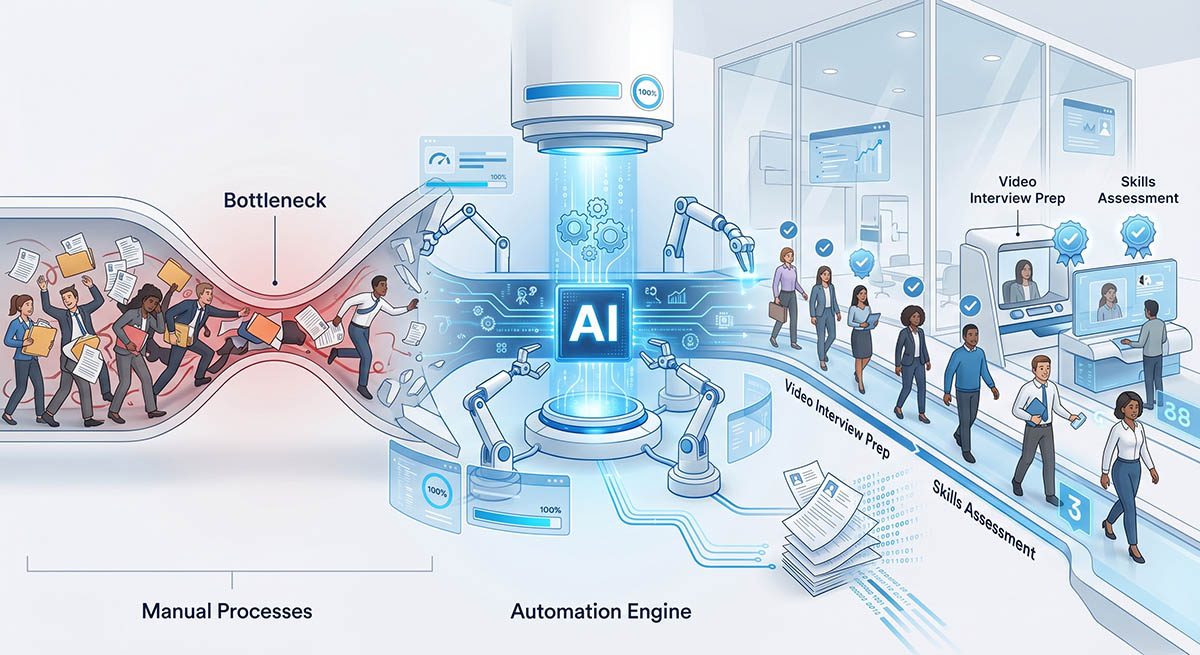
Automation reduces that friction. It can quickly match candidates to role requirements, generate shortlists, and manage scheduling and communication without delays. This allows hiring teams to move faster without increasing workload.
At the same time, not every part of hiring should be automated. Evaluating soft skills, communication, and long-term fit still requires human judgment. The most effective systems combine both, using automation to improve efficiency while preserving thoughtful decision-making.
Some roles require deeper involvement, while others can move through a more streamlined process. Adjusting your approach based on the role helps maintain both speed and quality.
Use LLM-Based Candidate Grading For Consistency
Manual screening slows hiring and introduces inconsistency. Different reviewers focus on different details, which makes it difficult to compare candidates fairly.
A structured system uses LLM-based grading to evaluate every applicant against the same criteria. Each candidate is assessed based on defined factors tied to the role, including experience, responses, and overall alignment.
Instead of sorting through resumes manually, hiring teams receive clear summaries, match scores, and requirement checklists that highlight why a candidate fits or does not fit the role. This speeds up decision-making while keeping evaluations consistent.
Know When To Bring In Outside Support
Some roles are difficult to fill internally. Specialized positions, urgent vacancies, and high-volume hiring often require more resources than a typical team can handle.
In practice, over half of Canadian businesses report ongoing difficulty finding the workers they need, leading to longer hours and operational strain.2 When internal teams are already stretched, adding full-cycle hiring to their workload can slow everything down further.
External partners can provide access to pre-screened candidates and reduce time spent on sourcing and early screening. They can also reach passive candidates who are not actively applying but are open to new opportunities.
This approach allows internal teams to focus on final decisions and onboarding instead of managing the entire recruitment process.
How We Can Help
Hirevu approaches hiring as a system, not a series of disconnected steps. We write job ads that speak directly to the right candidates, using clear outcomes and positioning that attract people who actually fit the role. From there, every applicant goes through a structured evaluation process powered by LLM-based grading. Each candidate is assessed against defined criteria, so decisions are based on evidence rather than instinct.
We also remove the delays that typically slow hiring down. Our workflow automatically invites qualified candidates to interviews through SMS and email, and candidates can book interview times directly without back-and-forth scheduling. Depending on your needs, you can choose between human recruiters or AI avatar recruiters to handle screening. This allows your team to focus on final decisions while we handle the heavy lifting in the early stages.
Final Thoughts
Hiring faster without sacrificing quality comes down to clarity and structure. Clear expectations lead to better candidates. Structured evaluation leads to better decisions. Faster communication keeps strong candidates engaged.
Speed and quality do not compete with each other. A well-designed process supports both.
References
- Statistics Canada. “Labour Force Survey, February 2026.” The Daily, 17 Mar. 2026, https://www150.statcan.gc.ca/n1/daily-quotidien/260317/dq260317a-eng.htm.
- Bouchard, Isabelle. How to Adapt to the Labour Shortage Situation: Hiring Difficulties Are Not Going Away. Business Development Bank of Canada, 2021.
