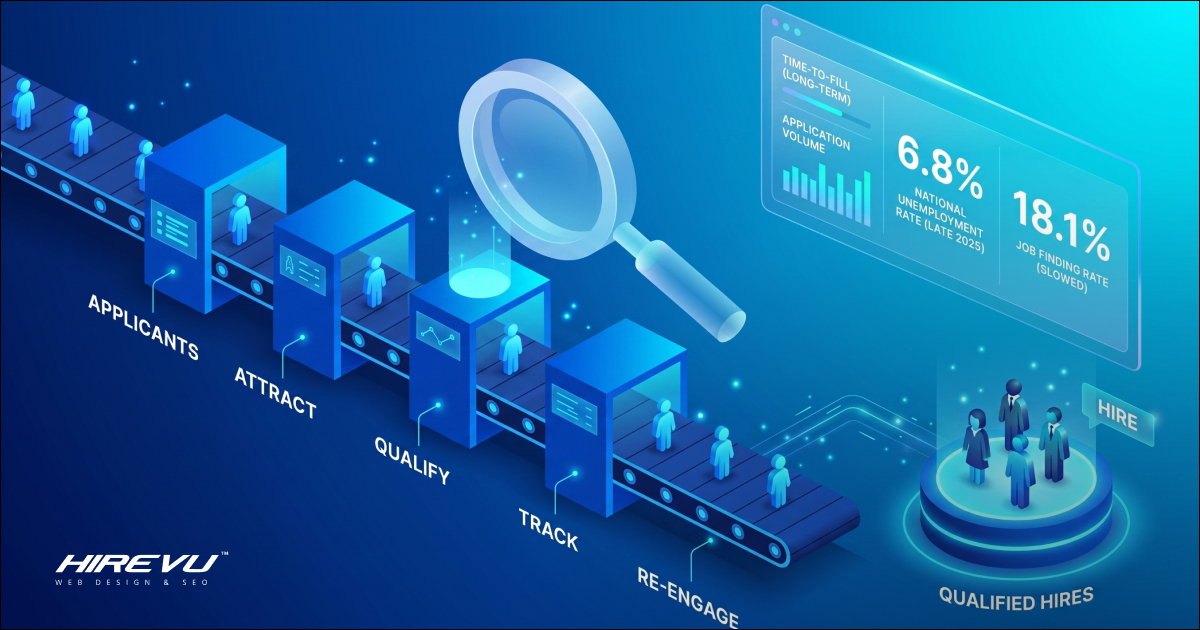
Canada’s labour market has become harder to read. In late 2025, the national unemployment rate stood at 6.8%, while the job finding rate slowed to 18.1%.1 More people were looking for work, but many were taking longer to move into new roles.
That creates a strange problem for employers. They may receive applications, yet still struggle to hire the right person. The issue is often not demand. It is weak structure. Great companies treat hiring like lead generation because they know candidates need to be attracted, qualified, tracked, and re-engaged.
The Hidden Problem: Why Hiring Feels So Inefficient
Hiring feels inefficient when every new role starts from scratch. A job post goes live. Applications arrive. Recruiters review resumes manually. Interviews get scheduled slowly. Strong candidates lose interest before the company reaches a decision.
The same problems show up again and again:
- Long timelines caused by slow screening and delayed follow-up
- Poor candidate quality from broad, generic job ads
- Drop-offs caused by long forms, repeated questions, and unclear next steps
- Lost opportunities when past qualified applicants are forgotten
This is expensive. A bad hire can cost up to 30% of that employee’s first-year earnings in lost productivity and re-hiring expenses.2 When companies treat hiring as a one-time transaction, they keep paying the same sourcing and screening cost for every role.
The Root Cause No One Talks About
Most companies do not have a hiring funnel. They have a sequence of tasks. Post the job. Review applicants. Book interviews. Make an offer.
A hiring funnel is the step-by-step path a candidate takes from first learning about the company to accepting a job offer. It shows where people enter, where they drop off, and which parts of the process need attention.
Without that funnel, teams guess. If candidates leave before applying, the job ad may be too vague. If they start the application and abandon it, the form may be too long. If qualified people disappear after interviews, the company may be responding too slowly.
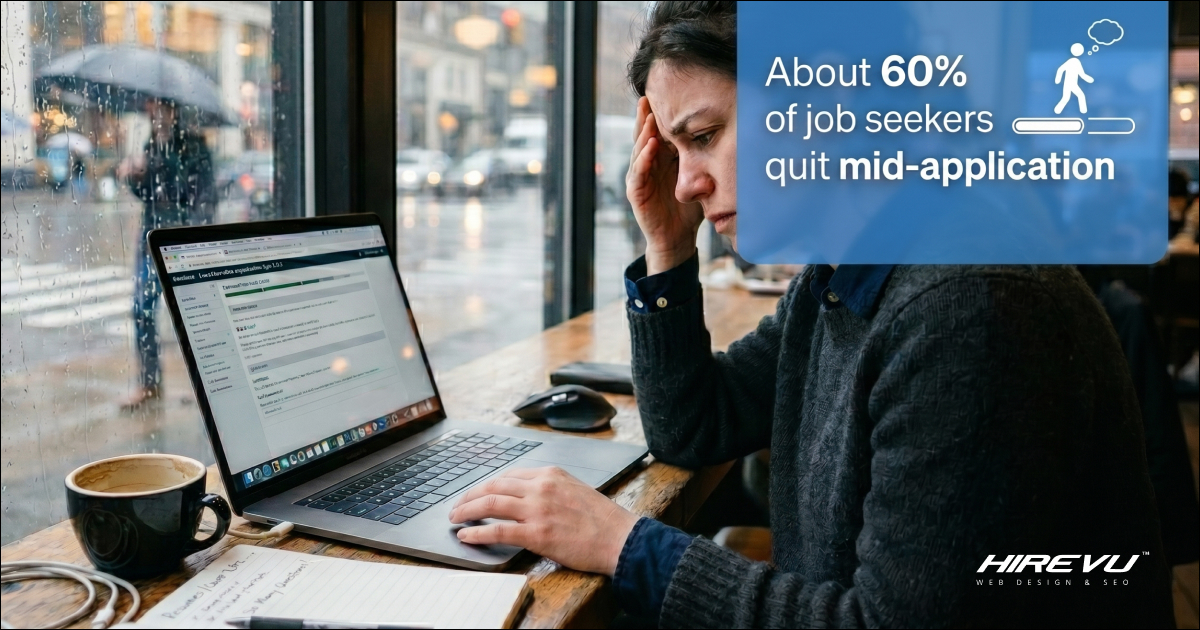
About 60% of job seekers quit mid-application when the process is too long, complex, or repetitive. That is lost candidate demand.
Hiring As A Lead Generation System
Treating hiring like lead generation means treating every candidate touchpoint with intent. The job ad works like a campaign asset. The career page works like a landing page. The application works like a conversion point. Screening works like lead scoring.
This is where marketing becomes part of recruiting. A strong job ad does more than list duties. It explains the problem the person will solve, the results they will be responsible for, and the reason the opportunity is worth considering. Stronger job ads focus on outcomes, business impact, compensation clarity, and scannable formatting.
That level of detail filters applicants before screening begins. A senior technician, clinic manager, sales representative, or operations lead can quickly decide whether the role fits their skills, expectations, and location.
What A High-Performing Hiring Funnel Looks Like
A strong hiring funnel has clear stages, metrics, and ownership. Each stage should answer a practical question.
| Hiring Stage | What It Means | What To Track |
| Awareness | Candidates notice the company or role | Career page visits |
| Interest | Candidates research the employer | Job post clicks and talent signups |
| Application | Candidates take action | Start-to-completion rate |
| Evaluation | Candidates are scored and screened | Interview-to-offer ratio |
| Hiring | Candidates accept or decline | Offer acceptance rate |
This structure gives managers a better way to diagnose problems. A low completion rate points to friction. A weak interview-to-offer ratio may mean screening is too loose. A low offer acceptance rate can reveal issues with pay, timing, or communication.
The best companies also keep a database of screened applicants. This is where hiring starts to get faster.
What A Screened Applicant Database Should Include
- Candidate name, location, and contact details
- Role fit, required licences, certifications, or technical skills
- Interview notes and screening score
- Salary expectations and availability
- Tags for future roles, such as “warehouse lead,” “inside sales,” or “clinic admin”
- Re-engagement status, such as “open later,” “not available,” or “ready now”
This prevents strong applicants from disappearing after one hiring round. A candidate who came second for a role in March may be the fastest qualified option when a similar role opens in June.
What Happens When You Get This Right

A lead generation model improves hiring because it reduces repeated work. Recruiters do not have to rebuild the candidate pool every time. They can return to people who were already assessed, tagged, and stored properly.
The benefits are practical:
- Faster hiring because screened applicants can be contacted first
- Better candidate quality because job ads filter for fit earlier
- Lower cost per hire because fewer resources are spent on weak-fit applicants
- Less recruiter workload because old screening data stays useful
- Better follow-up because candidates are tracked through defined stages
Speed also improves. Companies with responsive hiring processes can reduce drop-off rates by 40% to 60% when they acknowledge applications quickly and provide timely feedback. A candidate database makes that easier because the company already knows who is worth contacting.
Why Most Companies Fail To Implement This
Most companies fail because the system behind hiring is too manual. Resumes sit in inboxes. Interview notes stay in separate documents. Past applicants are hard to search. No one can quickly pull up “qualified service technician near Mississauga” or “previously screened receptionist with clinic experience.”
Tracking is another issue. If no one measures application completion, interview conversion, or offer acceptance, hiring problems stay hidden. The team may blame the labour market when the real issue is slow follow-up or poor job ad targeting.
Automation is often missing too. A candidate who passes the first screen should receive the next step quickly. That could be an SMS interview invite, an email with available times, or a short screening interview request. Waiting several days gives competitors room to move first.
Accessibility also matters. There are more than 1 million Canadians with disabilities who are ready to work but may be blocked by inaccessible hiring systems. A hiring funnel should work for real applicants using different devices, tools, and support needs.
How Hirevu™ Solves This
Hirevu™ helps companies turn recruiting into a structured lead generation system. The process starts with better job messaging, so each role attracts candidates who understand the work, requirements, and expectations before they apply.
From there, applicants are screened against defined criteria. Each candidate can be graded, tagged, and stored in a searchable database. When another role opens, employers can return to qualified applicants instead of starting the search from zero.
Hirevu™ also supports automated SMS and email interview invites, which keeps candidates moving while interest is still fresh. Companies can use human recruiters, AI-supported workflows, or a mix of both, depending on hiring volume and budget.
The value is simple. Better ads bring in better applicants. Structured screening identifies fit faster. A database of screened candidates makes future recruiting quicker.
FAQs
A hiring funnel is the path candidates follow from first seeing a role to accepting an offer. It helps employers track awareness, applications, screening, interviews, offers, and drop-offs.
Both rely on attracting the right people, qualifying them, tracking movement through stages, and following up quickly. Poor targeting brings low-fit leads. Poor follow-up loses qualified ones.
A screened applicant database helps companies reuse past recruiting work. Qualified candidates can be tagged and contacted again when a similar role opens.
Useful hiring metrics include application completion rate, interview-to-offer ratio, cost per hire, offer acceptance rate, time to hire, and first-year retention.
Conclusion
Great companies treat hiring like lead generation because recruiting works better when it is structured. Candidates need to be attracted with clear messaging, screened with consistent criteria, and stored in a system that makes future hiring faster.
The companies that win talent do not restart from zero for every role. They build a pipeline of screened applicants, track where candidates drop off, and move quickly when the right person appears. That is how hiring becomes faster, clearer, and easier to repeat.
References
- Government of Canada, Statistics Canada. The Daily — Labour Force Survey, December 2025. 9 Jan. 2026, www150.statcan.gc.ca/n1/daily-quotidien/260109/dq260109a-eng.htm.
- Schooley, Skye. “How to Handle a Bad Hire.” business.com, 23 Mar. 2024, www.business.com/articles/cost-of-a-bad-hire.