Health care and social assistance is projected to add more than 2.2 million U.S. jobs from 2025 to 2035, roughly 37% of all new employment, according to the U.S. Bureau of Labor Statistics.¹ Private medical practices compete for many of those workers, often against hospitals with deeper budgets.
One figure deserves more attention than it gets. In August 2026, the sector’s job opening rate was 5.4%, compared with 4.3% across all industries.² Qualified candidates in health care hold more options than job seekers almost anywhere else, so the practice that screens quickly and communicates clearly usually lands the hire.
Five recruitment trends are reshaping how practices find, vet and keep staff.
1. Shortages Are Deepest in the Roles Practices Rely On
Practices feel the squeeze most in clinical support and primary care, where demand outpaces supply.
| Role | What the Data Shows |
|---|---|
| Medical assistants | 13% projected growth and about 109,700 openings a year |
| Registered nurses | 39.9% plan to leave or retire within five years |
| Family physicians | Supply projected to meet only 76% of demand in 2038³ |
Retirements will widen those gaps further. One in five clinical physicians in the U.S. is already 65 or older.
Posting a job only after someone resigns leaves a practice short for weeks. Owners who recruit year round and write job ads that sell the schedule, team and workload are better placed when a key person leaves. Few office managers have time for constant sourcing, so many hand that work to a healthcare staffing agency.
2. Application Overload Is Burying Strong Candidates

Generative AI lets anyone produce a polished, tailored application in seconds. On one large freelance platform, the average number of applications per job post rose from about 29 before large language models to nearly 63 after.⁴
Each application also tells you less. Yale researchers saw the link between a tailored letter and a callback drop by 51% once an AI cover letter tool launched, with employers leaning harder on work history instead.
That pile eats into hours practices rarely have, and SHRM already puts the typical time to fill at roughly a month and a half. A strict scorecard for every role keeps screening fast and fair. Credentials, scope of practice, verified experience and availability should carry the weight, while cover letters count for very little.
3. Credential Fraud Has Reached Health Care

Fake qualifications have moved beyond a padded résumé. In Operation Nightingale, two Florida schools sold more than 7,600 fraudulent nursing diplomas, and some buyers used them to obtain licences and nursing jobs.⁵
Video interviews open another door. The FBI has warned that deepfakes and stolen personal information are being used to apply for remote jobs, with mismatched lip movement and audio among the warning signs.
A dependable verification routine covers three checks:
- Confirm identity at the interview and again at onboarding, and meet finalists in person where possible, as the FBI advises.
- Verify every nurse on the regulator’s public register. The College of Nurses of Ontario strongly encourages employers to do so whether they hire directly or through an agency.
- For U.S. practices, screen staff monthly against the federal exclusion list, which the HHS Office of Inspector General says best limits liability.
Skipping that last step gets expensive. Employing an excluded individual can bring a civil penalty of up to $25,595 per item or service (eCFR).⁶
4. AI Is Becoming a Standard Hiring Tool
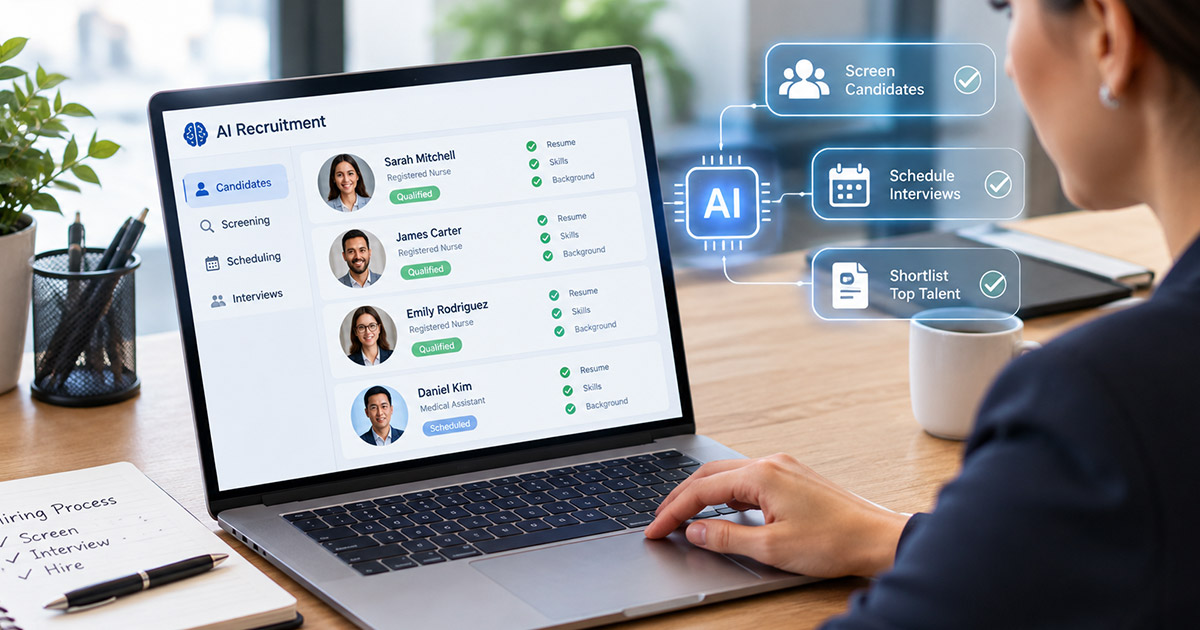
Recruiting is where HR teams are putting AI to work first. In a 2026 survey of 1,908 HR professionals, SHRM found 39% of organizations had implemented AI in HR, with recruiting as the leading use.
Larger employers are moving faster. The U.S. Census Bureau put overall business AI use at 19.8% in early May 2026, yet use reached 37% among firms with 250 or more employees, while firms with fewer than 20 showed no significant change. With AI-powered recruitment in place, a small practice can screen and schedule at a pace most peers cannot yet match.
Most Americans still want a person making the final call; a Pew Research Center report puts opposition to AI doing it at 71%.⁷ Let software sort applicants, score them and book interviews. The offer itself belongs with someone who knows the practice.
5. Candidate Experience Decides Who Says Yes
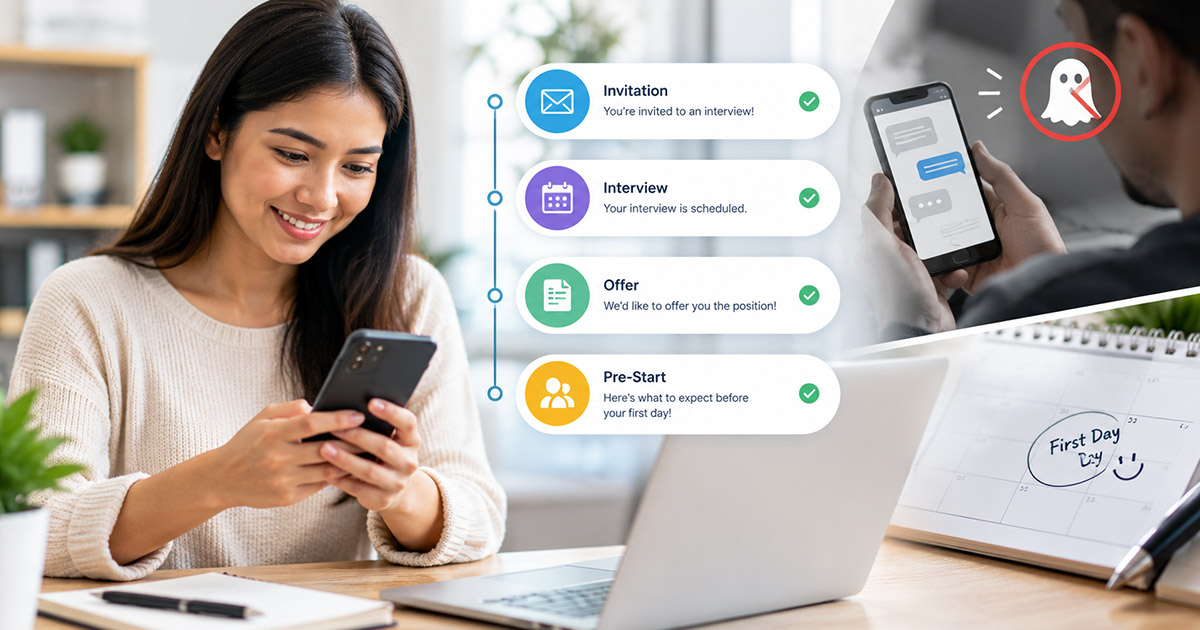
Candidates who vanish halfway through the process cost practices time and money. Among organizations struggling to recruit, 41% name candidate ghosting as a top challenge in SHRM’s 2025 Talent Trends research.
Silence after an accepted offer carries risk too. At one large U.S. employer, 4.1% of accepted offers never turned into a first day, a 2026 study in the Human Resource Management Journal reports, and longer gaps between offer and start date raised that risk.⁸ Weaker contact during that waiting period was also linked to ghosting.
Short, regular updates by text and email at each stage (invitation, interview, offer and the week before the new hire begins) keep candidates engaged and less tempted by competing offers.
Final Thoughts
Health care hiring will stay competitive for years, and the numbers above leave little room to wait for applicants. The practices spending the least time with empty chairs will be those that market their roles, screen against clear criteria, verify every credential and keep candidates informed. Technology can absorb the volume, though the hiring decision should stay with people who understand your patients and culture.
How We Can Help
We build hiring systems for private medical practices. Our team writes job ads that market your practice to candidates, screens every applicant with AI against strict criteria for each role, and sends automated text and email invitations to screening interviews. Depending on your budget, those interviews are led by our human recruiters or by AI avatar recruiters, and you make the final hire.
When you are ready to fill open roles with qualified candidates, visit us for a quote.
References
- “Employment Projections 2025-2035.” U.S. Bureau of Labor Statistics, Aug. 2026, www.bls.gov/news.release/ecopro.nr0.htm. Accessed 13 Oct. 2026.
- “JOLTS Table 1: Job Openings by Industry.” U.S. Bureau of Labor Statistics, Sept. 2026, www.bls.gov/news.release/jolts.t01.htm. Accessed 13 Oct. 2026.
- “Physician Workforce Projections.” Health Resources and Services Administration, Dec. 2025, bhw.hrsa.gov/sites/default/files/bureau-health-workforce/data-research/physicians-projections-factsheet.pdf. Accessed 13 Oct. 2026.
- Galdin, Anais, and Jesse Silbert. “Making Talk Cheap: Generative AI and Labor Market Signaling.” arXiv, 11 Nov. 2025, arxiv.org/abs/2511.08785v1. Accessed 13 Oct. 2026.
- “Fraudulent Nursing Diploma Scheme Leads to Federal Convictions.” U.S. Department of Justice, U.S. Attorney’s Office, Southern District of Florida, Dec. 2023, www.justice.gov/usao-sdfl/pr/fraudulent-nursing-diploma-scheme-leads-federal-convictions-0. Accessed 13 Oct. 2026.
- “45 CFR 102.3: Civil Monetary Penalty Adjustments.” Electronic Code of Federal Regulations, 2025, www.ecfr.gov/current/title-45/subtitle-A/subchapter-A/part-102/section-102.3. Accessed 13 Oct. 2026.
- “AI in Hiring and Evaluating Workers: What Americans Think.” Pew Research Center, 20 Apr. 2023, www.pewresearch.org/internet/2023/04/20/ai-in-hiring-and-evaluating-workers-what-americans-think/. Accessed 13 Oct. 2026.
- Speer et al. “Now You See Them, Now You Don’t: Understanding New Hire Ghosting and Its Antecedents.” Human Resource Management Journal, 2026, https://doi.org/10.1111/1748-8583.70050. Accessed 13 Oct. 2026.